
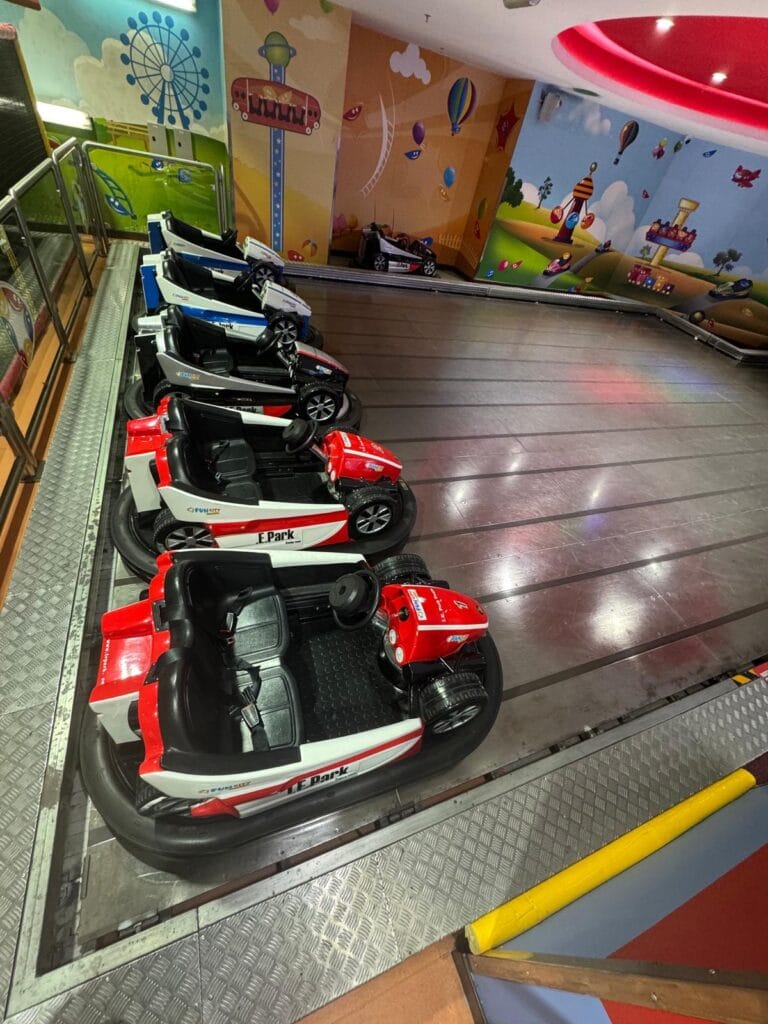
Bumper cars are one of the most dependable attractions you can put in a park or family entertainment centre. They work indoors and outdoors, they appeal to almost every age group above about six, they handle high throughput, and unlike a big thrill ride they rarely sit idle. That combination is why used bumper cars for sale come up so often when operators plan their first serious attraction.
This guide covers what you actually buy when you buy a bumper car set, how many cars you need, how much floor space it takes, what it costs to run, and what to check before you hand over any money.
What a used bumper car package actually includes
This is the first thing buyers get wrong. You are not just buying cars. A working bumper car attraction is a system with several parts, and a cheap listing that includes only the vehicles can leave you with a very expensive gap to fill.
A complete package normally includes:
- The cars themselves, including chassis, body, motor, bumper ring and seating.
- The floor, which is the conductive driving surface, usually steel panels laid on a prepared base.
- The ceiling grid on classic systems, which carries the power that the pole and contact shoe pick up.
- The power supply and control system, including transformers, the operator console and emergency stop.
- The barrier or pavilion structure, the surrounding rail, and often the roof and lighting.
- Theming and lighting, which is what actually makes the attraction look worth paying for.
Always confirm in writing which of these are included. A set of twelve cars with no floor and no grid is not a bumper car ride, it is twelve cars.
The three main types of bumper car system
Understanding the power system matters, because it decides your installation cost and where the attraction can go.
Ceiling grid systems
The traditional design. Power runs through an overhead grid, and each car has a pole with a contact shoe reaching up to it. Current passes down through the car and returns through the conductive floor. These are reliable and proven, they suit permanent indoor installations, and they need enough ceiling height for the grid, which rules out some low buildings.
Floor pickup systems
Power and return both come through a specially built floor, with no overhead grid required. The advantage is a clean look with no ceiling structure, which works well in venues with height limits or where the ceiling is a design feature. The floor itself is more complex and more expensive to build.
Battery powered cars
Each car carries its own battery, so no electrified floor or grid is needed at all. These can run on almost any flat surface, which makes them flexible and popular for temporary setups and smaller venues. The trade off is battery management, charging time between sessions and eventual battery replacement, all of which are ongoing costs the other systems do not have.
How many bumper cars do you need?
The honest answer is that it depends on your floor size and your expected throughput, not on a fixed number. But there are some useful principles.
Each car needs enough room to move and be hit without the floor becoming a permanent traffic jam. Too few cars on a large floor feels empty and riders get bored. Too many on a small floor means nobody can build up any speed, which is the entire point of the attraction.
Smaller indoor installations in family entertainment centres commonly run somewhere in the range of six to twelve cars. Larger park installations and outdoor pavilions run considerably more. The right way to decide is to work backwards from three numbers: the floor area you have available, the ride cycle length you plan to run, and the number of riders per hour you need to serve at peak.
Remember that a two seat car serves two riders per cycle, so a mix of single and two seat cars changes your capacity without changing your car count.
What size floor do you need?
Floor size is the constraint that decides everything else, so measure before you shop.
You need the driving surface itself, plus the surrounding barrier, plus a queue and loading area, plus operator access. Buyers regularly forget the last three and end up with a floor that technically fits the building but leaves nowhere for people to stand.
Also check the practical requirements of the space:
- Ceiling height, especially if you are buying a ceiling grid system.
- Floor loading, since a steel floor plus cars plus riders is a real weight.
- Power supply, because the transformers need adequate incoming electrical capacity.
- Ventilation for indoor installations.
- Access for installation, since floor panels and structure have to physically get into the building.
What do used bumper cars cost?
There is no single price, because the range is enormous. A handful of used cars in fair condition and a complete turnkey pavilion with floor, grid, structure, lighting and theming are different purchases by an order of magnitude.
The variables that move the price are:
- The number of cars and whether they are single or two seat.
- Whether the floor, grid and structure are included or you need to build them.
- The manufacturer, with established European makers such as Bertazzon and Reverchon holding value better than budget alternatives.
- Condition, operating hours and how much refurbishment is required.
- Theming and lighting, which is often where a tired set becomes presentable again.
- Shipping and installation to your site.
As always, compare total delivered and installed cost rather than the headline number. A cheap set of cars with no floor, worn motors and dead upholstery can easily cost more once it is actually running than a better package bought properly. Our guide to theme park equipment costs puts this in context against other ride categories.
Running costs and maintenance
Bumper cars are mechanically simple compared with a thrill ride, and that is a large part of their appeal. But they take constant physical punishment by design, so maintenance is routine rather than occasional.
Expect to budget for:
- Contact shoes and brushes on grid systems, which are consumables and wear steadily.
- Bumper rings, which absorb every impact and eventually need replacing.
- Motors, drive belts and wiring, checked regularly for wear.
- Floor condition, since a damaged or corroded conductive floor causes intermittent power faults.
- Seat belts, seats and upholstery, which take heavy use and are highly visible to guests.
- Batteries on battery powered systems, which are a significant recurring cost.
- Daily safety checks before opening, covering restraints, emergency stop and general condition.
The good news is that most of this is inexpensive and predictable. The bad news is that if it is skipped, the attraction looks tired fast, and a tired bumper car floor stops earning very quickly.
What to check before you buy used
Work through this before committing:
- Confirm exactly what is included. Cars, floor, grid, structure, transformers, control console, spares. Get it in writing.
- Count working cars, not total cars. Ask how many are currently operational versus how many are being sold as parts donors.
- Inspect the floor panels for corrosion, warping and damage, because floor replacement is a major cost.
- Test the electrical system under load, not just switched on.
- Check bodies and fibreglass for cracks, and remember that fresh paint can hide a lot.
- Assess the upholstery and seat belts, since these are what your guests actually touch.
- Ask for the manual and maintenance records. A package with documentation is far easier to install, certify and insure.
- Confirm spare parts availability for the specific manufacturer and model.
If you want the full process for vetting any used ride, our 47 point inspection checklist walks through it point by point.
Why bumper cars work well for FECs
For a family entertainment centre specifically, bumper cars solve several problems at once. They deliver high throughput in a compact footprint, they suit a wide age range so families ride together, they run in any weather because they are indoors, and they generate repeat rides within a single visit in a way that a one off thrill ride does not.
They also age well commercially. A refurbished bumper car floor with fresh cars, new lighting and updated theming reads as a new attraction to guests, even though the underlying system may be decades old. Few attractions give you that much visual improvement for that little money.
How GT Amusement can help
We buy, inspect, refurbish and supply used bumper cars and complete packages to operators worldwide. Every set is described honestly by condition, and we will tell you plainly what is included and what is not, because the gap between those two things is where most bumper car purchases go wrong.
Through our refurbishment service we can rebuild motors and drive components, replace bumper rings and contact assemblies, repair bodywork and repaint, renew upholstery and seat belts, upgrade lighting and theming, and test the complete system before it ships. We can also support you afterwards through our after sale service, because a bumper car floor is a long term asset and it needs parts and advice for years, not weeks.
Frequently asked questions
How many bumper cars do I need?
It depends on your floor size and the throughput you need rather than a fixed number. Smaller indoor FEC installations commonly run in the region of six to twelve cars, while larger park pavilions run considerably more. Work backwards from your available floor area, your planned cycle length and the riders per hour you need at peak. Remember two seat cars double the riders per car per cycle.
What size floor do I need for bumper cars?
You need the driving surface, the surrounding barrier, a queue and loading area, and operator access. Measure the full space, not just the driving area, and also check ceiling height if you are buying a ceiling grid system, floor loading capacity, incoming electrical supply and whether the panels and structure can physically be brought into the building.
Are bumper cars electric?
Yes, all of them, but the power delivery differs. Ceiling grid systems draw power from an overhead grid through a pole and contact shoe. Floor pickup systems take power and return through a specially built floor with no overhead structure. Battery powered cars carry their own batteries and need no electrified floor or grid, which makes them flexible but adds charging and battery replacement costs.
What is the maintenance cost of bumper cars?
Lower than most rides, because they are mechanically simple, but it is constant rather than occasional. Budget for contact shoes and brushes, bumper rings, motor and belt wear, floor condition, seats and upholstery, and batteries on battery systems. Most items are inexpensive individually. The real risk is skipping them, because a tired bumper car floor loses its appeal fast.
Are battery powered bumper cars worth more?
They can be, because they install almost anywhere without an electrified floor or ceiling grid, which saves significant installation cost and suits venues with height limits. Against that, batteries need charging time between sessions and eventual replacement, which is an ongoing cost grid systems do not have. Which is worth more depends entirely on your venue.
Looking for bumper cars? Browse our current inventory to see available packages, and ask our team what is included, what condition it is in, and what a fully delivered and installed price looks like for your venue.