
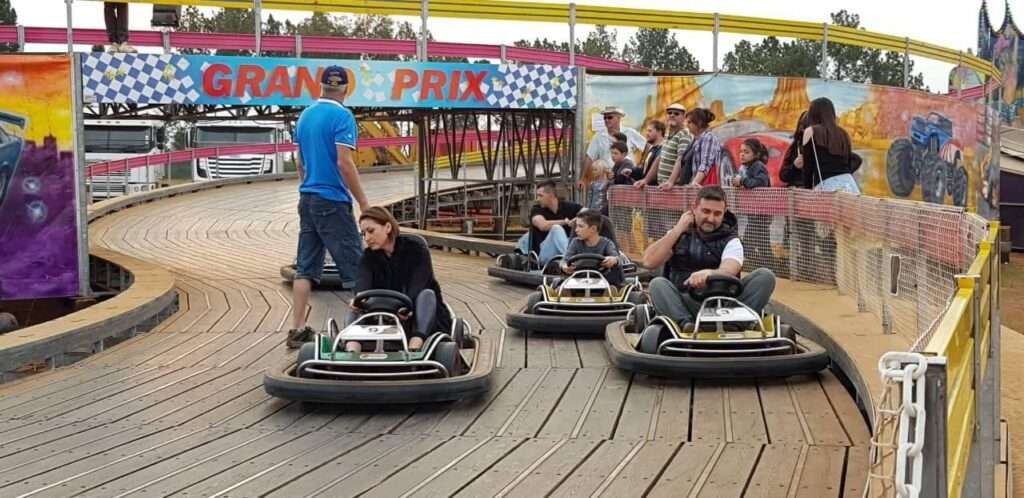
A used commercial go-kart costs between 1,500 and 4,000 euros, a new one between 4,000 and 9,000, and a park or family entertainment centre needs ten to thirty of them plus a track, which is why the fleet, not the individual kart, is the number that matters. This guide is for operators buying karts to earn money with, not for someone buying a kart to race. It covers the types of commercial kart, what a fleet costs used and new, petrol against electric, how to size a track, and what to inspect on a second-hand kart before paying.
GT Amusement buys, refurbishes and resells used amusement equipment, and go-karts are one of the lines we stock, so the figures below come from fleets we have handled rather than a manufacturer’s price list.
Why go-karts earn more than almost anything else in a park
A go-kart track is the rare attraction that adults queue for on their own behalf, not because a child dragged them there. Sessions are short, eight to ten minutes, the price per session is high for the time spent, and the track runs from opening to closing with no cycle gaps. Per square metre a busy track out-earns most rides in the park, and it draws the teenage and adult segment that children’s rides cannot reach.
The cost side is different from a ride. A ride is one machine. A track is a fleet of small machines that each need fuel or charging, tyres, brakes and bodywork, plus a track surface, barriers and a pit lane. Buying used cuts the fleet cost by half or more, but only if the karts are commercial grade to begin with.
Commercial karts are not recreational karts
Most “go karts for sale” listings are for private use: single-seat racing karts, off-road buggies or home-built machines. None of them belong on a commercial track. A commercial or concession kart is built for hundreds of hours a year in the hands of people who have never driven one, and it looks different.
- Full perimeter bumpers so contact between karts damages nothing.
- Enclosed rear engine or motor bay so nobody touches a hot or moving part.
- Four-point harness or lap belt and a fixed seat sized for adults, with a two-seat version for a parent and a small child.
- Remote speed control or kill switch so the marshal can slow or stop the whole fleet from the pit.
- Speed limited by design, typically 30 to 50 kilometres an hour for rental use.
If a kart being sold as commercial lacks any of these, it is a recreational kart and it will not pass an operator inspection.
What a fleet costs, used and new
Ranges are for the European secondary market and for new karts from established commercial manufacturers. A fleet is usually ten to thirty karts. Add the track separately.
- Used petrol commercial karts: 1,500 to 4,000 euros each. Most commonly 200 to 270 cc four-stroke engines of 6.5 to 9 horsepower. Cheap to run and easy to repair, which is why they dominate the used market.
- New petrol commercial karts: 4,000 to 9,000 euros each.
- Used electric commercial karts: 3,000 to 7,000 euros each, and rarer, because electric fleets are newer and batteries age.
- New electric commercial karts: 6,000 to 14,000 euros each.
- Two-seater and children’s karts: used 1,500 to 3,500 euros, new 3,500 to 8,000 euros. Every family track needs some.
So a fifteen-kart used petrol fleet lands around 25,000 to 60,000 euros, against 60,000 to 135,000 euros new. Budget a further 20 to 30 percent for spares, helmets, timing equipment and the first season’s tyres, and treat the track itself as a separate project.
Petrol or electric
This is the first decision and it is mostly decided by the venue.
Indoor tracks, including anything in a mall, are electric. There is no exhaust to ventilate, no fuel to store, and the noise is low enough for the shops next door. In the Gulf, where summer heat pushes leisure indoors for months, this is the growth format, and it is almost always electric. The cost is higher per kart, batteries need replacing every three to five years, and you need charging bays for a third of the fleet at any time.
Outdoor tracks are usually petrol. Cheaper to buy, refuelled in seconds rather than charged for an hour, and repairable by any small engine mechanic. The trade-offs are noise, fumes and fuel storage, all of which rule petrol out indoors.
A used petrol fleet is the lowest-cost route into karting. A used electric fleet needs a careful look at battery condition, covered below.
Sizing the track
The track decides the fleet size, not the other way round. A compact indoor circuit of 200 to 300 metres runs eight to twelve karts at once. An outdoor concession track of 400 to 700 metres runs twelve to twenty. Allow two metres of run-off inside barriers on every corner, a pit lane long enough to load a full session at once, and a pit area with space for charging or fuelling, spares and a kart lift.
Fleet size should be the number on track at once plus 30 to 50 percent, so that karts can rotate out for charging, cooling or repair without shortening sessions. Twelve on track means sixteen to eighteen in the fleet.
Karting sits inside the wider family of driving attractions. Racing rides such as our Speed Way and Drift Race deliver a similar feeling in a fixed-track format for venues that lack the floor space for a real circuit, and the choice between them is covered in our guide to the types of amusement park rides.
What to inspect on a used kart
Check every kart in the fleet, not a sample. Fleets are sold as a whole and the seller’s best three karts are always the ones at the front.
- Chassis. Look for cracked or re-welded tubes, especially around the engine mounts and the front axle. Commercial karts get hit from every side and a chassis that has been straightened once will bend again.
- Engine hours or battery cycles. Petrol engines should have hour meters, and 1,500 hours is a working life for a rental engine before a rebuild. Electric karts should show battery cycle counts and a capacity test, and a battery below 70 percent of original capacity is due for replacement, at several hundred euros per kart.
- Brakes. Hydraulic disc brakes on the rear axle, sometimes on all four wheels. Check disc thickness, pad wear and the master cylinder for leaks. This is the one item that must be perfect on every kart.
- Steering and axle. Play in the steering column, worn tie-rod ends, and bearing noise on the rear axle. All cheap parts, all essential.
- Bumpers and bodywork. Cracked plastic bumpers are cosmetic but a bumper missing its mounting bracket is a chassis repair.
- Restraints and kill switch. Every belt must latch and every kart must stop on the remote command. Test the remote system with the full fleet, not one kart.
- Tyres. Rental tyres last 200 to 400 hours. A fleet on worn tyres is a fleet with a 2,000 euro bill attached.
- Paperwork. Manufacturer, model, serial numbers, and the previous operator’s inspection records. The commercial go-kart standard most inspection bodies reference is ASTM F2007, and a fleet from a maker that builds to it is worth more than one that does not.
The general method for inspecting any used equipment is in our 47 point inspection checklist, and the purchase process end to end is in the complete used ride buyer’s guide.
Refurbishment
A tired but sound petrol fleet responds well to a proper refurbishment: engine service or rebuild, new brakes, new tyres, replaced bumpers and a repaint in your venue’s colours. Budget 800 to 1,500 euros per kart and four to eight weeks for a fleet. Done properly, a refurbished used fleet is indistinguishable from new on the track and costs roughly half. Our refurbishment service handles this, including matching a fleet to your branding before delivery.
Frequently asked questions
How much do commercial go-karts cost?
Used petrol karts 1,500 to 4,000 euros each, new 4,000 to 9,000. Electric roughly double. A fifteen-kart used fleet is typically 25,000 to 60,000 euros before the track.
How many karts do I need?
The number on track at once plus 30 to 50 percent. A compact indoor track runs eight to twelve at once, so a fleet of twelve to eighteen. An outdoor track runs twelve to twenty, so eighteen to thirty.
Petrol or electric for a mall?
Electric, without exception. No fumes, no fuel storage, low noise. Petrol is for outdoor tracks.
Does GT Amusement sell go-karts?
Yes. The go-kart listing shows what is in stock, and we source fleets to a specification when a venue needs a particular size or type. Send the track dimensions and whether the venue is indoor or outdoor through the contact page and we will put a fleet together.
The short version
Buy commercial-grade karts only, buy the whole fleet on inspection, and let the venue decide petrol or electric. Chassis and brakes are what you are paying for. Bodywork and paint are what the refurbishment fixes. Everything currently in stock is on the used rides list.