
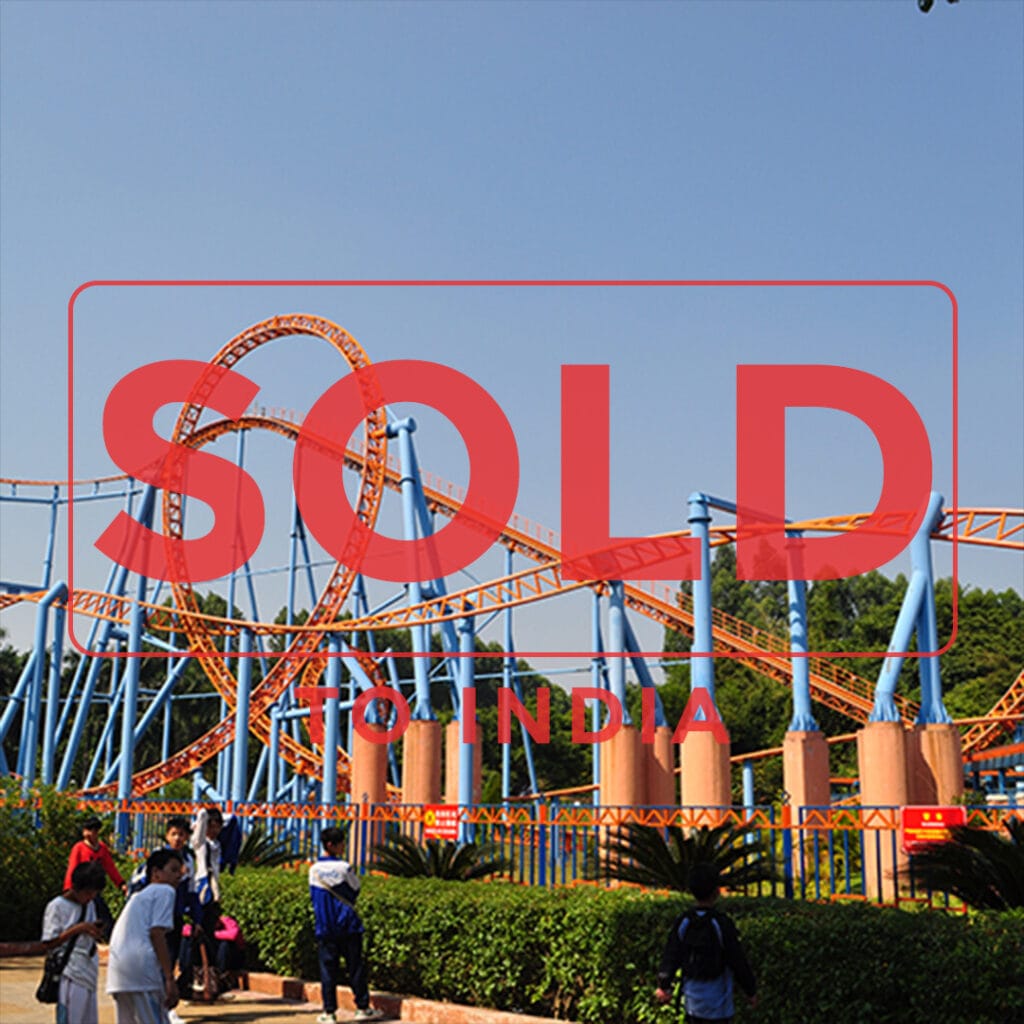
Amusement park rides fall into nine families: roller coasters, flat rides, tower and drop rides, spinning rides, family and children’s rides, water rides, dark rides and media attractions, transport rides, and carousels. Every ride in every park in the world belongs to one of them, and once you can name the family you can predict a ride’s footprint, its throughput, its power draw and roughly what it costs. This guide walks through all nine, with the common models inside each, the kind of park each suits, and realistic price ranges for used and new equipment.
GT Amusement buys, refurbishes and resells used European rides across every one of these families, so where we have a ride of that type in stock or have sold one recently, it is linked. Where we quote prices they are typical secondary market ranges, not offers.
1. Roller coasters
The headline attraction of any park. A coaster is a vehicle on a fixed track that uses gravity, and sometimes a launch, to move through drops, turns and inversions. Coasters split into families of their own.
- Family and junior coasters. Low height limits, gentle drops, one to two minute rides. The entry point for most parks and the first coaster a child rides. Used 40,000 to 120,000 euros.
- Wild mouse and spinning coasters. Tight hairpin turns on a compact footprint, sometimes with cars that spin. High thrill per square metre. Used 150,000 to 400,000 euros.
- Shuttle coasters. Out and back along the same track, forwards then backwards. The Boomerang design is the classic example. Used 300,000 to 800,000 euros.
- Looping and inverting coasters. Full circuit rides with one or more inversions, up to the multi-inversion machines like the 10 Inversion Roller Coaster. Used 500,000 euros to several million.
Coasters are the most complex purchase in the industry, involving foundations, track inspection and long installation. Our guide to buying a used roller coaster covers the process, and the Roller Coaster DataBase is the reference for the history and specification of almost every coaster ever built.
2. Flat rides
The industry term for rides that move on a fixed base rather than along a track. This is the largest family and the backbone of every fairground and mid-size park. Flat rides are compact, transportable, and offer the best thrill for their footprint and price.
- Top Spin and inverting platforms. A gondola between two arms that flips riders through the vertical. The Top Spin is the defining example. Used 150,000 to 400,000 euros.
- Enterprise and Ferris-style wheels. Gondolas on a wheel that tilts to vertical. The Enterprise has been a fairground staple for fifty years. Used 100,000 to 300,000 euros.
- Pendulum rides. A gondola swinging on an arm, from the gentle pirate ship to the giant frisbee. The Condor and the Power Surge are in this family. Used 80,000 to 500,000 euros.
- Vortex and multi-axis rides. Arms that rotate on several axes at once. See the Vortex and the Ranger. Used 100,000 to 350,000 euros.
Flat rides are where the used market is deepest, because travelling showmen replace them regularly and the machines are built to be moved. Our guide to used carnival rides covers buying from that market.
3. Tower and drop rides
Riders are lifted up a vertical tower and dropped, bounced or swung. Towers are the tallest structures in most parks and the most visible from outside the gate, which is a marketing asset in itself.
- Drop towers. A gondola lifted to the top and released into free fall, from 20 metre family versions to 100 metre giants. The Sky Drop and the Scary Drop are compact examples. Used 80,000 to 600,000 euros.
- Bounce towers. Gentler versions that bounce riders up and down the tower. The Power Tower is one. Used 60,000 to 250,000 euros.
- Swing towers. Seats on chains around a rotating hub that rises up a mast. The Samba Tower is the family-friendly form. Used 100,000 to 400,000 euros.
4. Spinning rides
Rides whose main motion is rotation, whether of the platform, the cars or both. This family produces the highest rider counts per hour in most parks and includes some of the oldest ride designs still in use.
- Waltzers and spinning platform rides. Cars on an undulating rotating platform that spin freely. The waltzer is the British and European classic, covered in our waltzer buyer’s guide. Used 20,000 to 200,000 euros.
- Tagada and disco rides. A round platform that spins and bounces with riders sitting around the edge. The TagaDisco is a modern example. Used 60,000 to 200,000 euros.
- Gravitrons and rotors. Centrifugal rides where riders are pinned to the wall by spin. See our Gravitron buyer’s guide. Used 40,000 to 150,000 euros.
- Dance and party rides. Music-driven spinning platforms for teenagers, such as the Dance Party 360. Used 80,000 to 250,000 euros.
5. Family and children’s rides
The rides that keep a family in the park. Children’s rides are sized for two to ten year olds and often let a parent ride along. Family rides admit everyone and thrill nobody, which is the point.
- Mini convoys, teacups and mini flying rides. The core of every family entertainment centre. Our guide to kiddie rides covers every type with prices. Used 8,000 to 60,000 euros.
- Family swingers and gentle pendulums. Slow swinging rides for all ages, such as the Family Swinger. Used 40,000 to 120,000 euros.
- Bumper cars. The one ride every park has. Covered in our bumper cars buyer’s guide. Used 30,000 to 150,000 euros for a full track with cars.
- Soft play and foam attractions. Unpowered or lightly powered indoor play structures such as the Soft Play Area and Foam Factory. Used 15,000 to 100,000 euros.
6. Water rides
Any ride where water is part of the experience, from a log flume to a splash battle. Water rides carry the highest installation cost of any family because they need pumps, filtration and a watertight channel, but they are the rides guests queue longest for on a hot day, which makes them essential in Gulf and Mediterranean parks.
- Log flumes and river rapids. Boats along a channel with drops or rapids. Used 200,000 euros to 1 million or more, plus civil works.
- Splash and interactive water rides. Smaller boats with water cannons, and themed water play such as the Sea World ride. Used 60,000 to 300,000 euros.
7. Dark rides and media attractions
Enclosed attractions where the experience is built from scenery, projection and motion rather than raw physics. Dark rides are the most themed and most expensive to build new, but media attractions have opened this family to smaller venues.
- Motion theatres. Seats that move in sync with a film. An XD Theater fits in a mall unit and needs no track at all. Used 60,000 to 250,000 euros.
- Ghost trains and themed dark rides. Vehicles through scenery on a fixed track. Used prices vary enormously with the theming, from 80,000 euros to several million.
8. Transport rides
Rides that move guests around the park, or let guests drive. Not thrilling, but among the highest earners per square metre because they run all day and every guest is a rider.
- Go-karts and driving tracks. Self-drive circuits such as our Go Kart track, and racing rides like the Speed Way and Drift Race. Used 30,000 to 200,000 euros.
- Trains, monorails and chairlifts. Park transport that doubles as a ride. Used from 50,000 euros for a small park train to millions for a monorail.
9. Carousels and Ferris wheels
The two rides that define the look of a park, and the two that last longest. Both are covered in dedicated guides: the used carousel buyer’s guide and the used Ferris wheel guide. Carousels run 10,000 to 500,000 euros used depending on size, and Ferris wheels from 100,000 euros for a compact wheel to several million for an observation wheel.
How to build a ride mix
A balanced small park or family entertainment centre draws from at least four of these families: something for the youngest children, a family ride everyone can share, one flat ride for thrill, and a carousel or wheel as the landmark. A mid-size park adds a coaster and a water ride. Throughput matters as much as thrill. Two rides that each move 500 riders an hour earn more than one ride that moves 300, even if the single ride is more exciting.
What each family costs to buy, ship and run is covered in our theme park equipment cost guide. The IAAPA publishes industry data and safety resources across every family, and ride safety standards referenced in most countries are maintained by ASTM Committee F24.
Frequently asked questions
What are the main types of amusement park rides?
Nine families: roller coasters, flat rides, tower and drop rides, spinning rides, family and children’s rides, water rides, dark rides and media attractions, transport rides, and carousels and Ferris wheels.
What is a flat ride?
A ride that moves on a fixed base rather than along a track. Top Spins, Enterprises, pendulums and most fairground rides are flat rides. They offer the best thrill for their footprint and are the deepest part of the used market.
Which rides earn the most?
Per square metre, bumper cars, go-karts and children’s rides, because they run all day and load fast. Per ride, a good coaster, because it sets the park’s reputation. A balanced park needs both.
Where can I buy used rides from these categories?
Our current used rides list covers most of the families above, and we source specific rides to order from our network of European parks, operators and auctions. Send the family and the budget through the contact page.
Two families deserve their own pages: see flat rides explained for everything that runs on a fixed base, and roller coaster inversions explained for what loops, cobra rolls and corkscrews mean when you buy a coaster.