
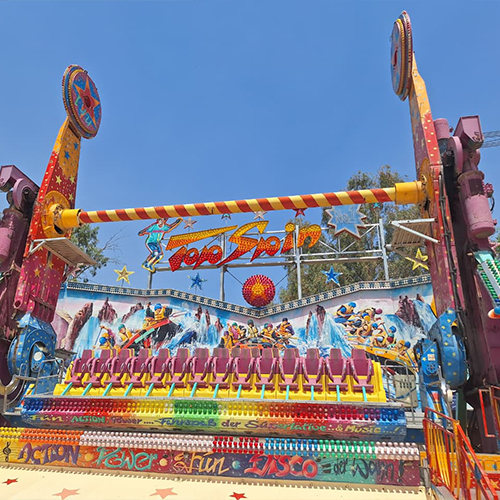
A flat ride is any amusement ride that works on a fixed base rather than along a track. Top Spins, Enterprises, Tagadiscos, Power Surges, swing towers and bumper cars are all flat rides. They are called flat because the whole machine sits on one level footprint, usually a trailer or a concrete pad, and the motion comes from arms, gondolas and platforms turning around that base. A roller coaster is the opposite: the thrill comes from a train moving along a track that climbs and drops. This guide explains the types of flat rides, what each costs used and new, how they compare with a coaster for a park or family entertainment centre, and what to check before buying one.
GT Amusement buys, refurbishes and resells used European flat rides, and most of the rides on our used rides list are flat rides, so the figures below come from machines we have inspected and shipped rather than from brochures.
Flat ride versus roller coaster: the real difference for an operator
Riders feel the difference as track against no track. Operators feel it in four other places.
- Footprint. A large flat ride such as a Top Spin needs about 20 by 25 metres. A family coaster needs 30 by 60 metres at the small end and the land has to be level. A flat ride fits where a coaster cannot.
- Installation. Most flat rides are trailer mounted or arrive in a handful of containers and run within days of delivery. A coaster needs foundations, a track survey and weeks of assembly.
- Cost per rider. A good used flat ride costs 60,000 to 400,000 euros and takes 20 to 50 riders a cycle. A used coaster starts around 300,000 euros for a small family model and runs into the millions. Per rider per hour, flat rides are the cheaper capacity.
- Thrill level. A Top Spin or an Enterprise produces forces that match a mid-sized coaster. For teenagers and adults, a strong flat ride does the job of a coaster at a fraction of the land and money. For a signature attraction that pulls people through the gate, a coaster is still the draw.
The practical answer for most parks is both: one coaster as the landmark, and flat rides for capacity, variety and the smaller budgets in between. For a mall, a fair or a family entertainment centre, flat rides are usually the whole answer.
Types of flat rides
There is no official taxonomy, but the trade sorts flat rides by the kind of motion they make. Here are the families you will meet when you shop for one, with examples we stock or regularly handle.
Spinning platform rides
A round platform turns while riders sit on it, often with a second motion added. The Tagadisco is the classic: a tilting, bouncing disc with riders holding a rail, no restraints, and a crowd of spectators every cycle. The Dance Party 360 and the Power Surge add rotating arms and inverting seats. These are the best earners per square metre in the flat ride world because they are loud, visible and fast to load.
Pendulum and swing rides
A gondola or set of seats swings on an arm, sometimes with rotation added. The Huss Top Spin is the most famous, a two-arm machine that flips a row of 40 riders through full rotations. The Enterprise lifts a spinning wheel of gondolas to the vertical. Swing rides are the thrill core of most European fairs.
Tower rides
Riders go up a vertical tower and come down, by drop, by bounce or by rotation. The Sky Drop is a drop tower, the Samba Tower is a gentle rotating family tower, and the Power Tower sits between them. Towers are the exception to the small-footprint rule in one direction only: they need little ground but a lot of height, so check your local height limits before you fall in love with one.
Rotating arm rides
Seats on the ends of arms that rotate around a hub, often with the arms tilting as they turn. The Vortex, the Okti and the Ranger are examples. The octopus and the paratrooper that older operators remember belong here too.
Family and kiddie flat rides
The same motions scaled down and slowed down. The Family Swinger, the Sea World, the Rainbow and the Mini Pirate are flat rides that a six year old can ride with a parent. Every family park needs a block of these, and they are the easiest flat rides to run indoors. Our kiddie rides guide covers this end of the range in detail.
Driven and interactive rides
Bumper cars, go-karts and drive-yourself tracks are flat rides where the rider controls the vehicle. They are the top earners for family entertainment centres and we cover them in our guides to used bumper cars and used go-karts.
What flat rides cost, used and new
Ranges are for the European secondary market and for new machines from the established manufacturers, delivered but before installation and shipping. Used prices assume a ride in running condition with documentation. A ride needing a rebuild sells for less and costs more in the end.
- Major thrill flat rides, Top Spin, Enterprise, large pendulums: used 150,000 to 450,000 euros, new 900,000 to 2,000,000 euros.
- Spinning platform rides, Tagadisco, Dance Party, Power Surge: used 60,000 to 250,000 euros, new 400,000 to 900,000 euros.
- Tower rides: used 120,000 to 500,000 euros depending on height, new 500,000 to 1,500,000 euros.
- Rotating arm rides: used 40,000 to 180,000 euros, new 250,000 to 600,000 euros.
- Family and kiddie flat rides: used 15,000 to 90,000 euros, new 60,000 to 300,000 euros.
Refurbishment adds 10 to 25 percent of the used price for a cosmetic refresh and new restraints, and more if the drive or hydraulics are due. Our refurbishment service quotes this before you commit, so the total is known.
Choosing a flat ride for your venue
Indoor family entertainment centre or mall: family flat rides, bumper cars, a small spinning ride, all electric. Ceiling height decides everything, so measure before you shortlist.
Outdoor park with a coaster already: one major thrill flat ride near the coaster for the same audience, then spinning platform rides for capacity.
Fair, carnival or travelling operation: trailer-mounted rides only, and ask how many people and hours the build-up takes. A Tagadisco sets up in a day; a large Top Spin takes a crew two days.
Gulf and hot climate venues: favour rides with shaded queues and quick cycles, and specify hydraulics and electronics rated for the heat. Most of what we ship goes to this climate and we refurbish with it in mind.
What to inspect on a used flat ride
- Structure. Cracks and repaired welds at the arm roots, the centre column and the trailer chassis. Ask for the last non-destructive test report; a serious seller has one.
- Drive and hydraulics. Hour counts on the motors, condition of the hydraulic pump and cylinders, leaks at the seals. Hydraulics are the usual expensive surprise on a Top Spin or Enterprise.
- Restraints. Every over-shoulder restraint and lap bar must lock and release correctly on every seat, and the locking system must fail safe. Replacing a full set of restraints is a five-figure job.
- Control system. Is the PLC programme available and documented? A ride with a dead controller and no code is a project, not a purchase.
- Electrics. Cabling, slip rings on rotating rides, and the lighting. LED retrofits cut the running cost and are a good sign the previous operator invested.
- Paperwork. Manufacturer, year, serial number, operating manual, inspection history and any certificate from a recognised body. In Europe most rides carry a TÜV or equivalent record; the standard most inspectors reference for amusement rides is ISO 17842.
The full method is in our 47 point inspection checklist, and the purchase process end to end is in the used ride buyer’s guide. For how flat rides sit alongside coasters, water rides and transport rides, see our guide to the types of amusement park rides.
Frequently asked questions
What is a flat ride?
An amusement ride that operates on a fixed base rather than along a track. The motion comes from arms, platforms or gondolas moving around that base. Top Spins, Enterprises, Tagadiscos, drop towers and bumper cars are flat rides. Roller coasters, log flumes and monorails are not.
Is a flat ride cheaper than a roller coaster?
Usually by a wide margin. A good used flat ride costs 60,000 to 450,000 euros and installs in days. A used family coaster starts around 300,000 euros before foundations and assembly, and larger coasters run into the millions.
Which flat rides earn the most?
Per square metre, spinning platform rides such as the Tagadisco and interactive rides such as bumper cars and go-karts, because they load fast and draw spectators. Per rider, major thrill rides such as the Top Spin command the highest ticket price.
Does GT Amusement sell flat rides?
Yes. Most of our stock is flat rides from European manufacturers, listed with photographs on the used rides page. Send the venue type and available space through the contact page and we will suggest what fits.
The short version
Flat rides give a venue capacity and thrills without the land, foundations and budget of a coaster. Buy the ride that fits your footprint and ceiling, buy it with its paperwork and a current inspection, and budget for restraints and hydraulics. Everything currently available is on the used rides list.