
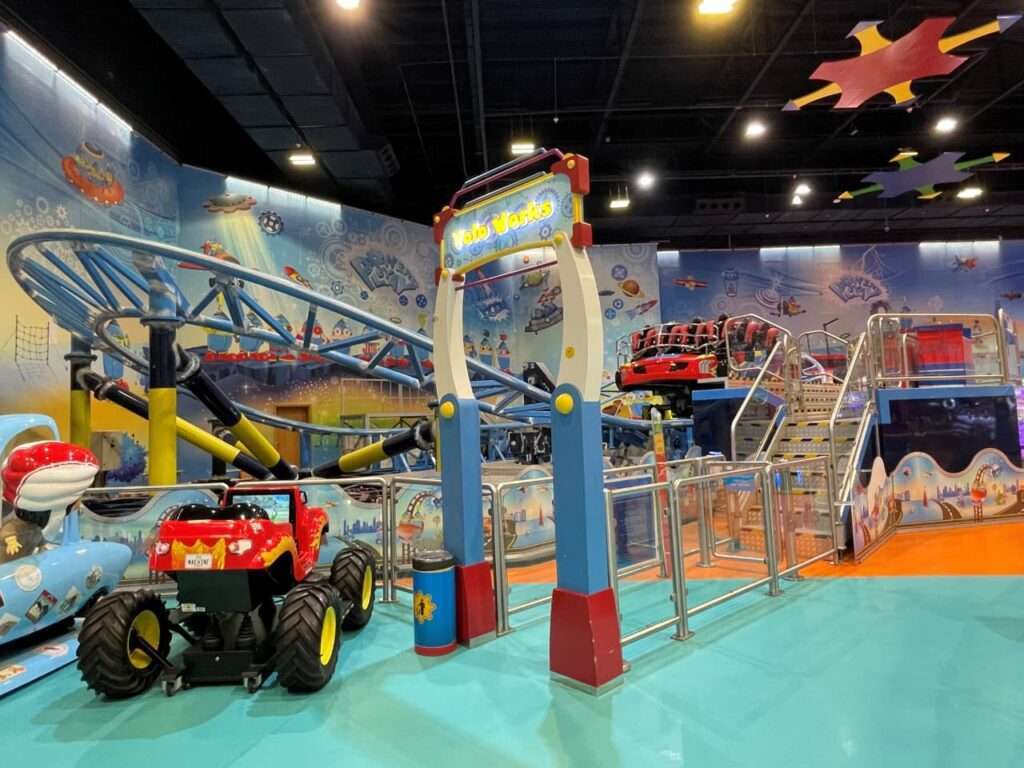
Roller coaster inversions are the points on a track where the train turns riders upside down. A vertical loop is one inversion, a corkscrew is one, a cobra roll counts as two because riders go over twice. A coaster described as a 10 inversion roller coaster turns its riders over ten times in one lap. This guide explains the common inversion types, what they mean for the rider and for the operator, what an inverting coaster costs used and new, and what to check before buying one.
GT Amusement buys, refurbishes and resells used European rides, including coasters. The figures below are indicative market guidance, not quotes. Current coasters are on our used rides list.
Why roller coaster inversions matter to a buyer
For a rider, inversions are the headline, because the number on the sign is what teenagers compare. For an operator, however, each inversion changes three things.
- Restraint type. Any coaster that inverts needs over-the-shoulder or vest restraints rather than lap bars. This also changes loading time, seat count and the cost of a restraint overhaul.
- Height requirement. Inverting coasters usually carry a minimum rider height of 120 to 140 centimetres, which removes the family market. A park that already has a family coaster can add an inverting one; a park with no coaster at all should usually start with a non-inverting family model.
- Track and structure. Every inversion is a section of track with high lateral and vertical loads, so inspection effort and track maintenance scale with the inversion count.
The main types of roller coaster inversions
Manufacturers use many names for these elements, and the roller coaster inversion entry on Wikipedia lists them in full. These are the ones you will meet most often.
Vertical loop
The original. The train climbs into a circle, goes over the top and comes down the other side. Modern loops are teardrop shaped so the forces stay comfortable. One inversion.
Corkscrew
A helix that rolls the train around a horizontal axis while it moves forward. Builders usually place them in pairs, so one follows the other. Each counts as one inversion.
Cobra roll
Two half loops joined by a half corkscrew, so the train enters one way and exits going back the way it came. It therefore counts as two inversions and is the signature element of the Vekoma Boomerang family, which rides it forwards and then backwards.
Sea serpent or batwing
Two inverted half loops linked so the train exits in the same direction it entered. It also counts as two inversions, and it is common on larger multi-inversion coasters.
Zero-g roll and heartline roll
A twist over the crest of a hill where riders feel weightless at the top. It is one inversion, but enthusiasts rate it highest for feel.
Dive loop and Immelmann
A half loop leads into a half twist, or the reverse. The Immelmann, for example, is named after an aircraft manoeuvre. Each counts as one inversion. Most 10 inversion coasters combine several of the above: typically a loop, a cobra roll, a sea serpent or two, a zero-g roll and a set of corkscrews.
Family coasters that invert, and ones that do not
Not every coaster inverts, and for most parks the first coaster should not. The Drifter Coaster in our stock is a spinning family coaster, which suits families and thrill seekers alike. A shuttle coaster such as the Vekoma Boomerang gives a park its first inversions, three of them each way, on a footprint of about 88 by 30 metres. Finally, large multi-inversion coasters are a landmark purchase for an established park with the land, the budget and the maintenance team to run one.

What roller coaster inversions cost
These are indicative ranges for the European secondary market and for new machines from established manufacturers, before foundations, shipping and installation.
- Used shuttle coaster, Boomerang type, 3 inversions each way: 400,000 to 900,000 euros. New: 2,500,000 to 4,000,000 euros.
- Used mid-sized looping coaster, 2 to 5 inversions: 600,000 to 1,800,000 euros. New: 4,000,000 to 8,000,000 euros.
- Used large multi-inversion coaster, 7 to 10 inversions: 1,500,000 to 4,000,000 euros. New: 8,000,000 to 20,000,000 euros.
- Used non-inverting family coaster, for comparison: 150,000 to 600,000 euros.
Add 15 to 30 percent of the used price for a proper refurbishment of a used coaster: track inspection and repair, train rebuild, new restraints, control system update and repaint. Then add the civil works at your site, which for a large coaster can match the price of the ride. Our refurbishment service quotes the ride side before you commit, and our guide on how much a roller coaster costs shows the full budget.
Relocating a used inverting coaster
Coasters are designed to be dismantled and moved; most large ones have been relocated at least once in their lives. The sequence is survey, numbered dismantling, non-destructive testing of every track section and train, repairs, transport in 20 to 60 containers depending on size, new foundations to the manufacturer’s loading plan, assembly, and a commissioning programme with test runs before the first rider. For a mid-sized inverting coaster, therefore, allow four to eight months from contract to opening. Our guide on how to buy a used roller coaster covers the contract and inspection side in detail.
What to inspect on roller coaster inversions
- Track in the inversions. Rail wear, weld condition and any cracks at the tie welds in the loop, cobra roll and corkscrews. These sections carry the highest loads, so fatigue shows there first. Therefore, insist on a magnetic particle or ultrasonic test report for every inverted section.
- Restraints. Over-the-shoulder restraints must lock on every seat with a redundant system and the release must be impossible while the train is away from the station. Moreover, replacing a full train of restraints is a six-figure job on a large coaster.
- Wheel assemblies. Road, up-stop and guide wheels on every car. Up-stop wheels take the load through inversions, so they wear fastest.
- Brakes and block system. Fail-safe brakes that close without power, and a block system that cannot let two trains into one section.
- Control system and documentation. The programme must be available, documented and transferable. Manufacturer, year, serial numbers, the operating manual and the full inspection history. In fact, coasters sold without their documentation are projects, not purchases.
The general method for any used ride is in our 47 point inspection checklist, and for how coasters compare with every other kind of ride, see the types of amusement park rides guide and flat rides explained.
Frequently asked questions
What does inversion mean on a roller coaster?
A point where the track turns riders upside down. A loop is one inversion, a cobra roll is two. A 10 inversion coaster turns riders over ten times in one ride.
How much does a 10 inversion roller coaster cost?
Used, between about 1.5 and 4 million euros for the ride, before foundations, transport and installation. New, between 8 and 20 million euros.
Can a park buy a used inverting coaster?
Yes. Large coasters are built to be dismantled and are regularly relocated. The buyer needs the land, the civil works budget and a maintenance team, and the ride needs full documentation and a current inspection.
Does GT Amusement sell inverting coasters?
Stock changes quickly, so check the used rides list for what is available now. Send the site dimensions through the contact page and we will tell you what could fit.
The short version
Inversions sell tickets to teenagers and adults, and each one adds restraint, height limit and maintenance obligations. A first coaster should usually not invert, but a second one should. Buy an inverting coaster only with full documentation and a non-destructive test of every inverted section, and budget the civil works alongside the ride.